
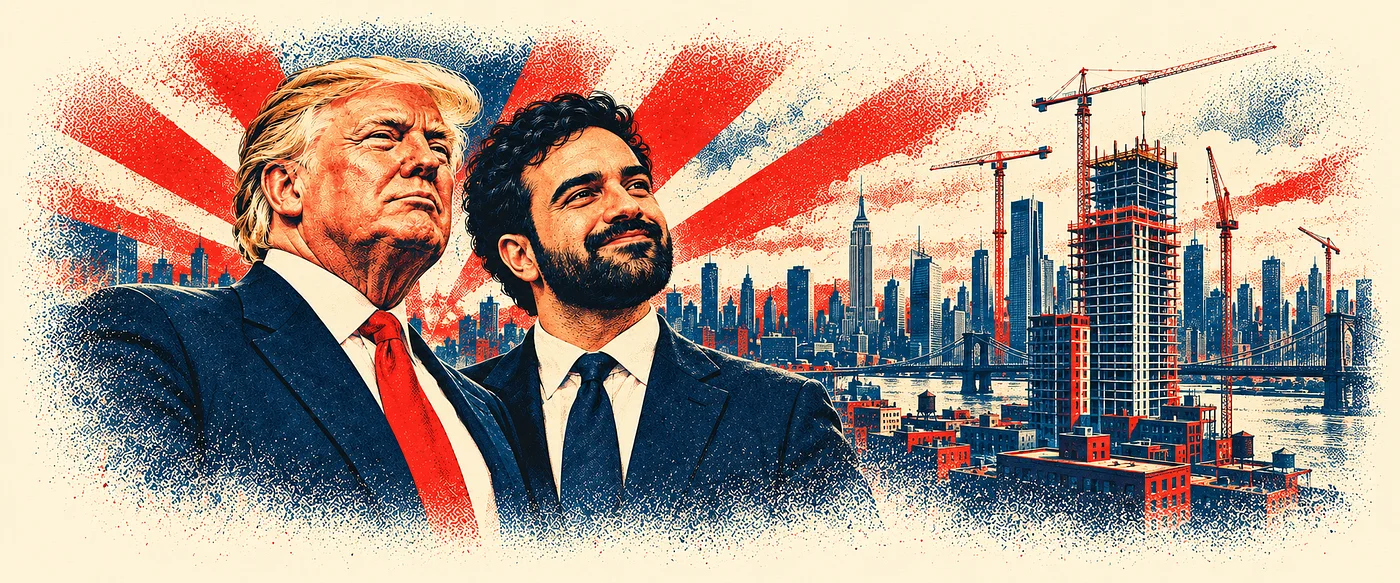
The Partnership
New York was the preparation. America is the assignment.
Before they considered governing together, Donald Trump and Zohran Mamdani approached the same city from different directions. Both concluded that it required their personal attention. One saw a city that could build more. The other saw a city its residents could no longer afford. Between them lay the possibility of an agreement, several substantial disagreements, and a considerable amount of real estate.
DONALD TRUMP
Donald Trump entered public life through New York real estate, a field in which ambition is measured in square footage and disagreements can outlast the buildings concerned. He built his reputation on a clear proposition: things could be bigger, more impressive, and more closely associated with Donald Trump. Buildings became a television career. Television became a political career. Throughout these transitions, the lettering remained consistent. His experience produced a distinctive approach to leadership: negotiate aggressively, announce confidently, and regard an initial refusal as an invitation to speak with someone more senior. He brings to the partnership a developer’s conviction that every problem has a solution, provided the relevant restrictions can be reconsidered.
ZOHRAN MAMDANI
Zohran Mamdani entered public life with a different assessment of New York real estate: people should be able to afford to live in it. His political work has centered on the daily costs of city life, including housing, transportation, and groceries. Where others saw expenses to be managed privately, he saw responsibilities to be assumed publicly. He developed a style suited to a city whose residents are busy, opinionated, and unlikely to stop walking simply because someone has a proposal. Make the case directly. Repeat it clearly. Arrive with enough volunteers. He brings to the partnership an organizer’s conviction that every problem has a solution, provided the relevant resources can be reassigned.
THE FIRST MEETING
When the two met in the Oval Office on November 21, 2025, their previous public statements suggested limited prospects for an agreeable afternoon. Instead, they discussed housing, groceries, utilities, and their shared attachment to New York. Trump praised Mamdani’s campaign and offered a direct assessment of their relationship: “The better he does, the happier I am.” Mamdani acknowledged their disagreements while emphasizing the work they could do for the city. The ideological differences remained substantial. The conversation had nevertheless reached the familiar New York question of whether something could be worked out.
A WORKING RELATIONSHIP
The conversation continued. By January, the president and mayor were exchanging text messages. A relationship that began with public denunciations now included direct access. In New York, this is a recognizable form of progress.
Mamdani later recalled standing with Trump before a portrait of Franklin Roosevelt during their first meeting. They discussed the federal partnership that had helped Mayor Fiorello La Guardia reshape New York. Mamdani returned to his team to develop a concrete proposal.
The relationship was beginning to involve homework, but they were ready.
COMMON GROUND, TO BE CONSTRUCTED
On February 26, 2026, Mamdani returned to Washington with a proposal for Sunnyside Yard: more than $21 billion in federal grants to support a development featuring 12,000 affordable homes, parks, schools, and health care facilities. The plan required an enormous deck over an active rail yard. Both sides agreed to continue discussions.
Here was a proposition capable of accommodating both political imaginations. Thousands of affordable homes. A development of exceptional scale. An opportunity to describe something as the largest of its kind. Their common ground would, quite literally, have to be built.
By September, the conversation had moved to Gracie Mansion. Further discussions of Sunnyside Yard, federal approvals, and affordability were had. Trump praised Mamdani’s potential, even if they didn't see eye to eye on media access. The relationship had become durable enough to accommodate another meeting without requiring either participant to become someone else.
THE NATIONAL PROPOSITION
This campaign takes the next, constitutionally unavailable but inevitable step. New York requires people with incompatible views to share buildings, negotiate terms, and establish who is responsible for the repairs. The country faces many of the same questions, across a larger maintenance area. Trump approaches them from the owner’s office. Mamdani approaches them from the tenants’ meeting. Between them, the ticket considers every floor represented.
Their administration would extend the relationship’s working methods nationwide: direct contact, ambitious construction, continued negotiations, and a shared expectation that the finished product should be both impressive and affordable. They have yet to reconcile who will own it, who will pay for it, or whose name will appear above the entrance. They consider these appropriate subjects for a second term.